Pregnancy
I'm Still Here- What didn't kill me made me stronger and sharperPregnancy is a consequential and changing condition in Janae Morrison’s story, first introduced through a startling disclosure that names Robert Walters as the father and later associated with her relationship with Jensen Brick McCall. It shifts private betrayal into a new question of responsibility and family, then culminates in the Christmas Day birth of Janae and Jensen’s daughter, Grace Pearl McCall. The available account does not explain the relationship between the initial paternity claim and the later birth, so both remain part of the record without an invented reconciliation.
Disclosure and Paternity
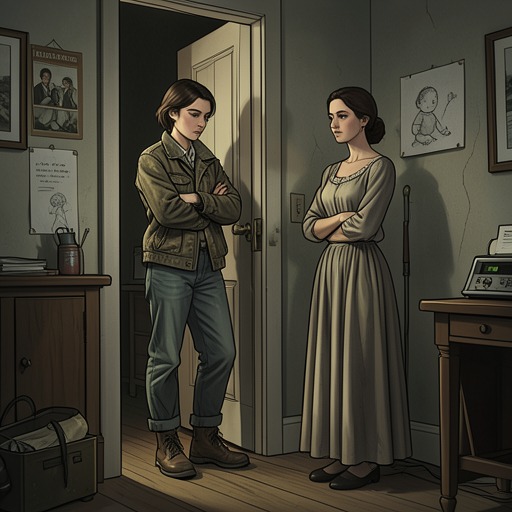
Janae reveals the pregnancy during a phone call. When the person on the other end asks why she is calling, she says she is pregnant; the response is disbelief and a demand to know who the father is. Janae answers that Robert Walters is the father of her baby. The disclosure is therefore not merely news of a child: it identifies a connection to Robert at a moment when his relationship with Janae carries the force of betrayal. The account gives the claim plainly, rather than surrounding it with explanation or qualification.
The immediate reaction is physical and abrupt: the phone drops, and the person narrating the moment cannot breathe. The text does not identify that speaker in the supplied passage, so the response cannot safely be assigned to Janae or to the person who asked the questions. What it does establish is the disclosure’s impact. A fact that had been private becomes impossible to absorb as ordinary conversation; the broken exchange registers shock before anyone can clarify what the pregnancy will mean.
Pregnancy and a New Relationship
Later, pregnancy appears in a markedly different emotional setting. Janae describes the love and care she receives from Jensen, recalling that he fed her breakfast and tended to her when she was broken down. She says she wants to apologize to her mother and sister and let go of that part of her life, even if she must love them from a distance. In the same reflection, she says she will soon be a mother. The pregnancy is thus placed alongside an effort to reconsider family ties and imagine a future, rather than treated only as a consequence of the earlier disclosure.
Janae’s counselor, Inya, places a hand on her belly. Janae describes feeling love growing inside her and thinks of the baby as giving Jensen life because he saved her. The passage joins pregnancy to gratitude and attachment, while showing that Janae’s expectation of motherhood is developing within a relationship shaped by care during her crisis. She then asks Inya to be the baby’s godmother, recognizing the boundary between counselor and patient even as she reaches toward a lasting personal bond. Pregnancy here draws the support around Janae into the future she imagines for her child.
Expectation, Loss, and the Limits of the Record
Jensen is later asked whether he is going to be a father. He acknowledges the prospect with a smirk, and the exchange continues as he says that this is one down and four more to go. The brief moment treats fatherhood as an anticipated change in his life and gives the pregnancy a place within the couple’s shared future. It does not, however, identify the child’s paternity in terms that resolve Janae’s earlier statement about Robert.
Another conversation in the supplied ending material refers to a baby who died and to a woman who has changed, moved out, and gone to study dance at Juilliard Arts. The passage does not clearly establish that this is Janae’s pregnancy or the baby previously mentioned. It therefore cannot be used to assert that Janae’s child died, or to supply an explanation for the later birth. Keeping that uncertainty visible matters: the evidence includes a report of a baby’s death, but does not securely connect it to the pregnancy at the center of Janae’s story.
Birth and Family
The closing account moves forward one year and records that on Christmas Day, Janae gives birth to Grace Pearl McCall. Jensen describes Janae as his wife, best friend, and family, and presents their daughter’s arrival as part of a household gathered around love. The pregnancy’s outcome is no longer an expectation or a question of fatherhood: a named child has been born, and Jensen locates himself within a family that includes Janae.
The birth also sits within a wider family reconstruction. Jensen says that his mother, the person who once attempted to take his life, is now his mother in the present and understands why he survived; he has given her a kidney so she can watch his brother and sister grow up. Mama Pearl holds her great-granddaughter and places a small crystal around her neck, a tradition she observes for every grandchild. These details make Grace’s birth an occasion that joins generations and inherited practices to the couple’s new family. Pregnancy consequently has two distinct narrative registers: an early disclosure entangled with Robert Walters, and a later culmination in Janae and Jensen’s daughter. The supplied evidence does not explain the transition between them, but the ending clearly establishes motherhood, fatherhood, and a child welcomed into an extended family.